Callsign
Amateur radio lookup at its finest
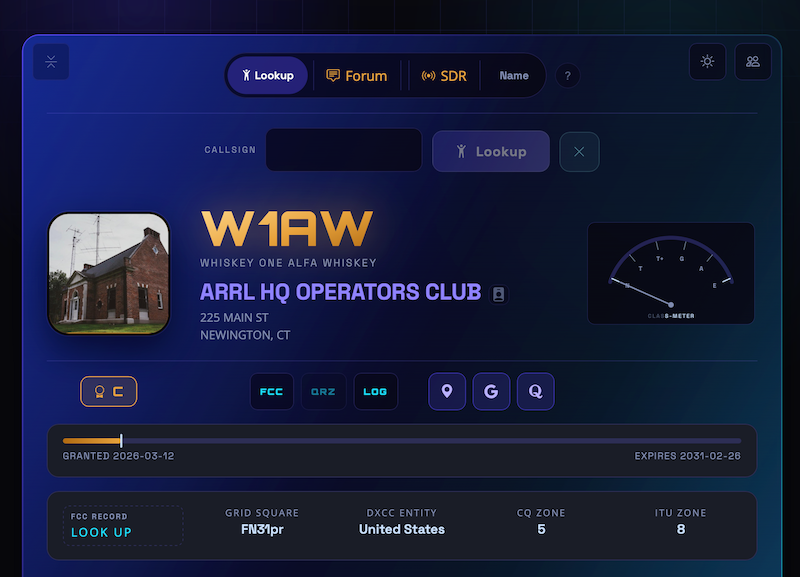
SKYe Callsign
Enter the consoleQRZ.com integration. Personal profile for registered hams, chat and forum exchange. The full FCC Universal Licensing System record, searched locally, plus offline DXCC resolution for any callsign on earth. Open to everyone — after showing knowledge of amateur radio. Profile requires FCC credentials.
What is in there
One console for the lookup, one logger for everything you work, and a profile of your own if you want one.
Who was that
The whole FCC Universal Licensing System record, searched against a local copy rather than somebody else's rate limit, with QRZ layered on top for the photograph, the biography and the rest of the world. Type a callsign, a name or an FRN. Offline DXCC resolution answers for every prefix on earth, licensed here or not.
Write it down as you work it
One box, one Enter, and the contact is in the log with the band, the mode, the reports and the UTC stamp already filled in. Names and locations arrive on their own from the lookup, so the log ends up carrying more than you had time to type. Exports as ADIF for LoTW or as CSV for anything else.
A run that does not stop for the mouse
Serials sent and received, the exchange you send held between contacts so it is typed once, a live rate, and dupes flagged the moment they are entered. The decoration gets out of the way for the duration — mid-run the only questions are what you sent and what you got back.
Parks, summits and park-to-park
Set the reference you are activating and the log knows what it is: references are checked against the program's own pattern before they can travel into an export, park-to-park and summit-to-summit are one field, and the UTC day rollover that splits an activation into two files is caught while you can still do something about it.
Everybody in the circle, in order
A net control operator is taking check-ins faster than anybody is working DX, and a roundtable is the same list going round again. Callsigns go in as they are heard and the names come back from the lookup, so the list reads as people rather than as letters — and it is a log at the end of it like any other.
Point the antenna
Every station lands on a map with the great-circle path drawn back to your own, the distance in miles and kilometres, and the bearing to turn the rotator to. Grid squares are drawn as the squares they actually are rather than as a false doorstep, and the map says in words how precise its pin is. Full screen, or a small window you can park in the corner and leave up.
A page of your own
Hold your callsign and you get a profile: your station, your antennas, whatever you want to write about any of it, and a gallery of your own photographs with a caption on each. Other operators reach it straight from the lookup, and the presence panel shows who else is on the site right now.
Crossman Software · Akron, Ohio